
Democratic Party Consultants Profit from Failure; We Must Shake Off Their Stranglehold
Mike Hersh, PDA Communications Director
Mike’s views are his own, and do not represent PDA’s official positions
Have you noticed a recurring pattern in Democratic Party politics? Democrats keep spending more and more money—ostensibly to win elections—but keep losing to increasingly extreme right wing Republicans. Have you wondered why the Democratic Party keeps losing winnable elections by hiring consultants who keep giving terrible advice (and cashing huge pay checks) while the country lurches further into fascism? It’s only a mystery if we fail to follow the money.
Like the producers in The Producers, high priced consultants win by losing. They cash in, even as the campaigns they advise fail. This raises questions about their abilities as well as their priorities. Their failed big donors over voters model mirrors their elitist policy prescriptions that alienate voters by putting profits over people.
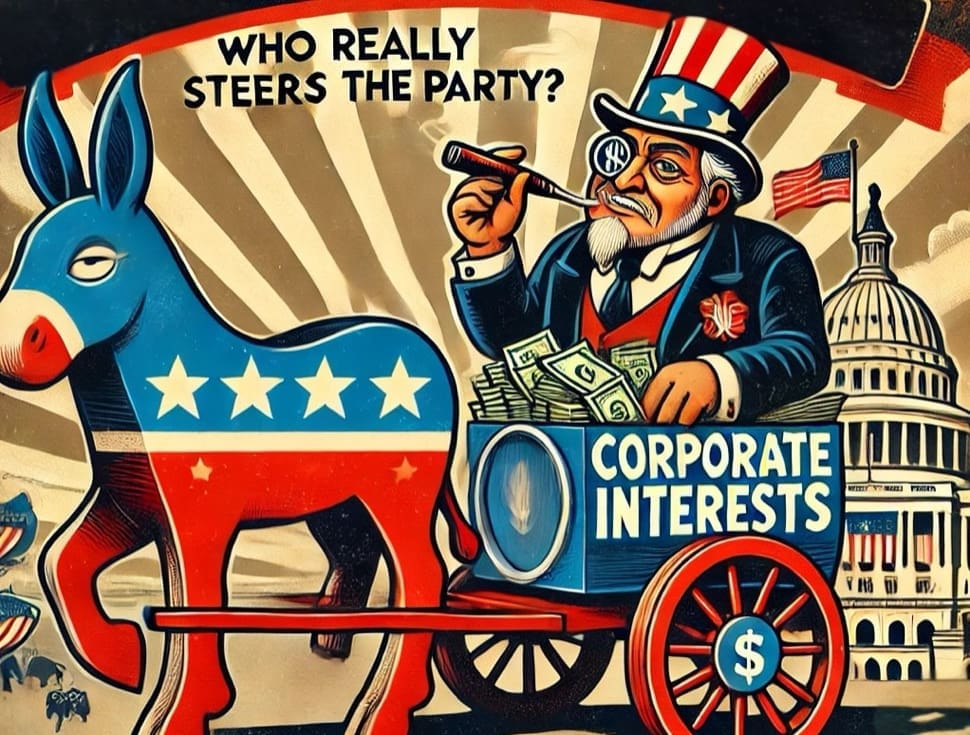
The consultants’ business model involves raising exorbitant sums from oligarchs, money with chains attached. In order to keep the money train running, these high priced insiders put the Democratic Party up for sale to the highest bidders. In this auction, popular policies and candidates—as well as the base voters—lose out. The consultants steer the party away from the people out for fear of offending the big right wing donors.
The current culture of consultant centricity arose in response to Ronald Reagan’s massive landslides in 1980 and 1984. Consultants arguing for this switch away from the base claimed that only moving to the center—in reality to the right of center—could Democrats compete successfully. Have they delivered on that promise?
There’s no question that becoming the oligarchs’ “side piece” opened the floodgates to a lot of big donors’ money. The record for delivering victories on Election Day remains mixed at best, however. This, because even if we concede that it takes massive amounts of money to win elections—true on the presidential level, but less so down ticket—we must consider two essential points:
Most importantly, money doesn’t vote. People do. At least they do when they’re inspired to support candidates who they trust to respect them in return. Money may buy 30 second TV commercials, but voters still determine the outcome of elections. The current crop of corporate consultants strongly signals that the Democratic Party prefers big donors to voter with predictably miserable results.
The consultants have shown an ability to compete for big donors’ money, but even so, they still come in second place. Almost all of those special interests with deepest pockets will always remain extremely fiscally and often socially conservative. Therefore, they will always stay with or go back to their first love, the Republican Party. This because they support an agenda of union busting and slashing their own taxes, as well as eliminating protections and programs people depend upon—the entire extreme hard right ideology. That’s where their loyalties lay, and once anyone takes their money, that’s where their loyalties lay as well.
Even if we accept that campaigns are expensive, there are alternatives to swearing fealty to oligarchs. Democrats will consistently come in second place in elections if we rely on right wing financing. Luckily, we don’t have to. We can fund campaigns through small grassroots donations instead. We can represent and rely on Main Street, but only if we stand up to Wall Street.
Bernie Sanders raised over $218 million through small donations during his 2016 presidential campaign and approximately $200 million through small donations in his 2020 presidential campaign. He set himself apart from business as usual politics, freeing himself to create a movement powered by ordinary people—rather than wealthy donors. He remains one of if not the most powerful and influential leaders in U.S. politics today.
Hillary Clinton’s 2016 presidential campaign also amassed a formidable war chest, with funding sourced from a combination of individual contributions, Political Action Committees (PACs), and large donations from wealthy donors. A significant portion of her campaign funds came from high-profile fundraising events and contributions from Wall Street and corporate executives.
Additionally, super PACs like Priorities USA Action played a crucial role in supporting her campaign, receiving substantial donations from affluent individuals, labor unions, and industry groups. Despite her substantial financial advantages, Clinton lost the Electoral College to Donald Trump. This even though Trump and his allies raised less than half of Clinton’s total.
How could this happen? Because money doesn’t translate into winning. Not when the candidate fails to reach out to the base. How did that happen? Because she listened to the consultants who are more focused on money than winning over voters to win elections. Mark Penn, a longtime Clinton strategist, played a significant role in shaping the campaign’s fatally flawed messaging.
Penn’s and therefore Clinton’s right of center campaign themes emphasized corporatism over the economic interests of U.S. families. This strategy was intended to appeal to moderate Republican voters, but failed to adequately archive that. It also failed to sufficiently energize the Democratic base. Clinton won the popular vote, but came up short where it counted most, in the decisive “rust belt” swing states, Pennsylvania, Wisconsin, and Michigan.
Penn advised both Bill and Hillary Clinton, but now frequents Fox News railing against the Democratic Party’s “woke” base. In his day job, he runs a private equity fund Stagwell, Inc. that’s received $millions in consulting contracts. His vision of the Democratic Party? Pro-Wall Street, anti-union, and allergic to real structural change. That is, 100% dead set against the Democratic Party base, its needs and vital interests.
Penn is far from alone in this. For decades, elite Democratic consultants have benefitted from a thriving industry—one seemingly more interested in courting corporate donors and maintaining D.C. cocktail party relevance than in building power. Certainly they’ve shown no concern for the working-class, multiracial Democratic Party base that actually votes. Or doesn’t vote if alienated by right-leaning wrong-headed lackluster campaigns. Worst of all, these so-called strategists seem more comfortable losing to Republicans than winning by working alongside progressives.
Fortunately, we don’t need these consultants or the oligarch’s money they raise and depend upon. Bernie Sanders demonstrated that we can depend on a broad base of individual contributors, reflecting widespread public enthusiasm and engagement with his political message. This became an advantage for his campaign, because it underscored his commitment to putting people first. He loudly declared his independence from the establishment and the consultants who serve it. This by rejecting large corporate donations, and by rejecting their influence.
In order to win general elections, we must reject oligarchs whose antipathy to the Democratic base undermines our candidates. Bernie’s fantastically successful fundraising proves we don’t need big money donors. He showed that we don’t have to blunt our message or kick our base under the bus. He did this by rebuking huge sums of campaign cash that come with chains attached.
What can we do about it? Read my next article, further exposing the consultant class that gives losing advice to Democratic Candidates in return for eye popping paychecks. I’ll introduce some of the “Second Place Club,” then explain how we must replace them with winning progressive policies and politics. Moving forward we must choose a side: fat cat donors or our base voters. Spoiler alert; almost all of the fat cats choose the Republicans.
Consider this: Bernie raised all that money even though most of his donors, myself included, didn’t really think he could win, or, if he did win, absent, a similarly progressive, Congress, enact our progressive agenda.
If there was a clear, plausible plan to address the bigger picture, I bet he would’ve had 10 times more donors and his donors would’ve contributed 10 times as much. I know that is true for me and several people I know.
Very thoughtful comments, Joe. If people are so willing to invest in an impossible dream, how many more would invest more in a possible, pragmatic plan?
Yes, all deadly accurate.
IMO, we will never see real change until money lobbying in government is made illegal.
Sadly, one cannot be elected without huge amounts of money and this creates the need for lobby money.
We need publicly funded elections and an end to wealthy powers controlling our elections.
Thank you Walter. Money is the root of all evil in politics.